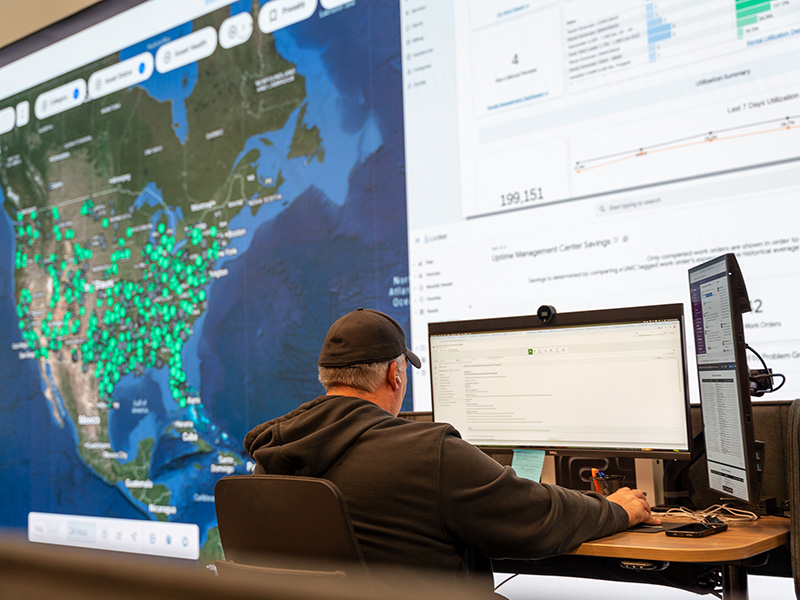
EquipmentShare is building the future of construction through its T3® platform that connects a historically fragmented industry. The latest evolution of this mission is the Uptime Center, which marries futuristic tech with a timeless commitment to customer service. By resolving the vast majority of machine issues within 24 hours, we are providing contractors and fleet managers with the ultimate easy button for jobsite certainty.
“Every construction company wants to improve efficiency and drive down the total cost of ownership for its equipment,” said Jeremy Pennington, EquipmentShare’s director of fleet monitoring. “This program can help do that.”
Consider this scenario:
On a quiet night on a construction site, the only sound is the hum of a generator powering the lights, security cameras and climate control equipment. But then the generator starts reporting diagnostic trouble codes (DTCs). On a deserted jobsite, those DTCs might not be noticed until it’s too late.
Fortunately, the DTCs are detected by our T3 technology installed on the generator. A fleet monitoring specialist hundreds of miles away at the Uptime Center sees the T3 alert and identifies the potential problem. The specialist contacts the EquipmentShare branch that services the jobsite. A service tech is dispatched to repair the generator before it fails, ensuring the project stays on schedule and the site remains safe and secure.
“You can’t physically be everywhere at once all the time,” Pennington said. “But with the Uptime Center, you can because you’ve got somebody at EquipmentShare watching your assets at all times and ensuring they perform. You can sleep easy at night.”
The Uptime Center — which opened in 2025 on EquipmentShare’s corporate campus in Columbia, Missouri — combines the leading-edge technology of T3 with a team of knowledgeable fleet monitoring specialists who provide around-the-clock coverage. It adds up to a maintenance program that can minimize downtime through proactive interventions that correct small issues before they become big problems that will delay a project.
“The machines are trying to tell us their story,” Pennington said. “Now we can understand it and take action before the customer knows about the issue.”
Harnessing the power of T3
The Uptime Center is powered by T3, EquipmentShare’s comprehensive cloud-based operating system that allows you to manage your assets, materials and people in one platform. T3 comes standard on EquipmentShare rental machines, and you can purchase it for all your owned equipment and vehicles — regardless of make or model. With T3, you can monitor the location, utilization and health of your entire mixed fleet from your phone or computer.
The fleet monitoring specialists at the Uptime Center use a T3 feature that combines real-time telematics and historical diagnostic trends to predict maintenance needs before they escalate and cause a machine to go down.
Each day, T3 collects and stores 6.4 billion data points from more than 394,000 connected assets nationwide. It’s the mother lode of construction equipment data. And it can be tapped to not only get incredible insight into the history of an individual machine but also to provide context based on the histories of other machines of the same make and model.
“'A customer might have two scissor lifts — we have 20,000,” Pennington said. “By identifying failure trends across thousands of similar machines, we can proactively service a customer’s equipment before they even know an issue exists. It’s the difference between fixing a machine and ensuring it never breaks.
“Another thing that sets us apart is we’re investing the effort and manpower to use all that data. We have experts in the seat watching all the alarms, working with the branches, working with the customer, troubleshooting, giving them advice and actually working through the issues to resolve them.”
The final piece of the puzzle is the expertise, speed and dedication of the local service teams who fix the equipment.
“None of this works without the branch,” Uptime Center Supervisor Nic Rainey said. “We hand them the clearest picture we can, but it’s their tech who’s on-site, doing the actual work and making sure the customer is taken care of.”
Unlocking productivity
EquipmentShare began piloting the Uptime Center fleet monitoring program in September 2025, watching machines on jobsites across the Mountain West region and on megasites nationwide.
Combining the Uptime Center's expertise with T3 technology, specialists separate urgent problems from issues that can wait, so technicians are dispatched where they’re needed most. For an idea of scale, in a 90-day period in the summer of 2026, fleet monitoring specialists reviewed more than 4,600 alerts across 1,500 machines. Specialists flagged more than 2,600 as urgent and sent them to service branches for repair. The other 2,000 didn’t require an immediate dispatch and were resolved with the operator, fixed remotely or added to the machine’s next scheduled service.
By the time a technician shows up, a specialist has already reviewed the machine's history in T3 and passed that information along to the branch, so the tech knows what to expect before ever touching the equipment.
“Think of T3 as the machine’s medical chart,” Pennington said. “If something’s acutely wrong, the machine reports it as a diagnostic trouble code, like a patient describing a symptom. But T3 also tracks its vitals over time, oil pressure, coolant temp, battery voltage, the way a chart tracks blood pressure or heart rate. A lot of what we catch is a trend drifting outside normal before anything actually fails. So by the time a tech needs to go out, we’ve already got it scoped out.”
Here are some examples of proactive Uptime Centers interventions that resolved potentially serious issues:
- When a generator at a Texas data center build showed a low coolant alarm, an Uptime Center fleet monitoring specialist reviewed the alert history and found two separate signals agreeing with each other: DTCs for both low coolant level and rising coolant temperature, plus an independent coolant temperature threshold alert firing on its own, all recurring over several days. That combination ruled out a single bad reading and confirmed an active coolant issue. Outcome: An EquipmentShare service tech found and replaced a failed coolant hose, keeping a 1,000kW generator online instead of letting it run toward an overheat shutdown.
- When a trash pump in Wyoming threw a cranking-voltage DTC, an Uptime Center fleet monitoring specialist pulled the battery voltage history and found it had been declining for several hours while the engine ran, instead of holding steady the way a healthy charging system would. That pattern pointed to an issue in the charging system, potentially the alternator. Outcome: An EquipmentShare service tech confirmed the alternator had failed and replaced it, restoring the charging system before the pump was ever left without power.
- When an air compressor at a refinery in Texas showed oil pressure slipping from 45 to 41 psi, an Uptime Center fleet monitoring specialist noticed the decline was slight but still fell outside the expected range. That flagged the compressor for investigation. Readings over time confirmed the pressure was continuing to fall rather than fluctuating back to normal. Outcome: An EquipmentShare service tech found oil coming out of the crankcase vent, traced it to a failed crankcase filter and made an emergency order for a replacement part to get it changed before the compressor lost any more oil.
- When a telehandler in Colorado reported an oil pressure reading stuck flat at 100 psi after previously reporting normal varying values, an Uptime Center fleet monitoring specialist recognized the flat reading as the signature of a stuck sensor rather than an actual pressure problem. Outcome: An EquipmentShare service tech ran a resistance test on the oil pressure switch, confirmed it had failed internally and replaced it. If it hadn’t been replaced, the bad sensor could have masked a real oil pressure drop in the future.
Building on the success of the pilot program, the Uptime Center is rapidly ramping up and will cover jobsites for EquipmentShare customers across the nation.
Adding ARMOR for protection
EquipmentShare now offers the ARMOR™ Program, a comprehensive preventive maintenance plan for your owned equipment. The ARMOR Program harnesses the power of T3 telematics and the vigilance and knowledge of the Uptime Center’s fleet monitoring specialists to give you the peace of mind of knowing the scheduled maintenance of your equipment is in the hands of experts.
How it works:
- ARMOR is a prepaid service contract you can choose when you purchase new or used equipment from EquipmentShare. It can also be purchased for T3-connected assets you already own if they have less than 6,000 hours of use. If you’re new to T3, it’s fast and easy to outfit your equipment with our technology.
- ARMOR coordinators at EquipmentShare’s Uptime Center track every enrolled machine, flag each service before it’s due, source the parts and dispatch a service tech from a nearby branch to perform the work.
It’s the latest innovation in EquipmentShare’s overarching goal of helping the construction industry break out of the rut that has caused its labor productivity to decline over the last five decades. A more personalized, precise maintenance program that’s always working — even when you’re not — can improve the reliability and longevity of your equipment and keep your jobs on track.
— Learn more about how EquipmentShare’s T3 platform can help you manage maintenance.